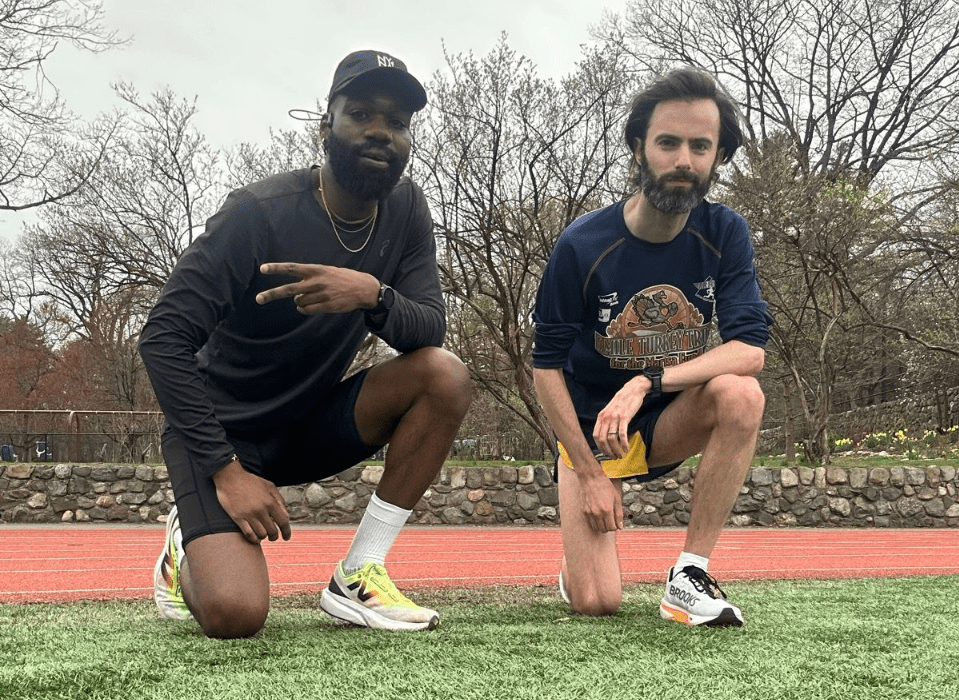
I started this blog a year ago, on the day of the Boston Marathon, having just watched the race from the wrong side of the cutoff for the second year in a row. Yesterday, I made it three.
Next year, well—I posted a 3:34:27 in Jersey City on Sunday. At least I won’t be getting any hate mail from the Boston Athletic Association this September.
Sunday was a disaster. After feeling ready to take on the world just one month earlier, I completely derailed my taper (and ultimately, my marathon) thanks to one little supplement it turns out I shouldn’t have been taking. Hindsight is 20/20, but that’s hard to stomach.
I don’t want to write this post. I’ll do my best.
After nailing down the logistics at bib pickup the day before, race morning went as smoothly as it could. I got to the start line—and, more importantly, the porta potties—in plenty of time. Conditions were excellent: 50 degrees and low wind. The rain that threatened the forecast all week had held off. I met up with Wis in the corral, nearly left one of my gels with my wife, found her in the crowd and retrieved it, bumped into a couple of my long run buddies right before the gun, and before I knew it we were off.
Something was off.
I just didn’t feel excited. In fact, I had a deep, nagging feeling that I would not succeed today. I felt this way before Philly, where I ended up logging the DNF that would give this blog its name. I tried to shake it off and just run.
Running felt good. I was clicking 6:20s with Wis and while that was a little ahead of the pace I planned, I couldn’t seem to slow down. My body wanted to run 6:20s at my dress rehearsal in Newark, and here it was again on autopilot. Maybe my fitness was still there after all?
It was, and it wasn’t. The first warning sign was at 4 miles, when I noticed my quads hurt a bit. I’d felt heavy in the first half of Rehoboth as well, and was able to fight that out, but this was very early. I got my first gel down, drank some water, and tried to relax.
This was my final, maybe fatal mistake—nothing new on race day. After training with just water, I added electrolytes to my bottle for the race. I wanted to give myself every chance at running well. I gave myself a tummy ache.
After trying to make it work a little longer, I decided to dump the bottle and refill with plain water at the mile 8 aid station. It was chaos, but I found a volunteer to help me fill up and after a few seconds I was back on my way.
My quads hurt worse for stopping, and Wis was gone. I could see his Garden State Track Club singlet up ahead, so I dug in for a long battle to reel him back in. At the very least, the water went down a lot better than the crap I was drinking before. Scratching the problem-solving part of my brain got me refocused. Nothing was going to plan, but maybe I still had a shot.
The miles were still rolling by, and for a while nothing got any worse. Maybe I really did have a shot.
I hit the half in about 84:20. It was fast, but my pace had been dead steady from the gun. My legs hurt but I was still moving. I knew I was coming up on the hard part of the course, but I also knew I was catching up to Wis and would be able to hop back in his pocket before long. I caught him around 15 and tried to ride along.
Something still didn’t feel right, like I knew it wasn’t going to work, but I kept fighting. I was already adjusting expectations. Sub-2:50, surely, would be an insane feat in this condition. Could I hang on for a PR? For a BQ, at least?
I’d been here before, on this course, in 2024, after an ill-advised surge in the middle miles, hurting like hell. I’d salvaged nearly enough to BQ back then. I knew I had to try.
I made it to 18 miles before the bargaining began. By 20 the bargaining had stopped. By 23 the running had stopped. My legs just stopped working.
I tried several times to start running again, and each time the pounding was just too much. My quads refused each step, painfully. Soon they protested walking, but I had to do that. People tried to cheer me on and I waved them off. The wind picked up and I was getting cold.
My split from 35K to 40K was 53 minutes. It was a surreal, out-of-context experience. I was moving slowly enough that for the first time in three races in Jersey City, I actually noticed the Statue of Liberty. I caught myself wishing I had my phone. My watch was still running.
Plenty of other people were still running, too. I tried to stay out of the way. Some of them tried to encourage me, which I appreciated more than the platitudes coming from spectators, but what was I supposed to do? Spiritually, this was a DNF. Finishing was just the fastest way back to my car.
Eventually, someone called out to me who I recognized. It was the winner of the March Madness Half from a month ago! This started to feel like a very weird dream. He had a few nice things to say as he went by, and I was so stunned that we recognized each other that I forgot most of them, but just before he disappeared, he called out, “Keep your chin up!”
I bawled like a baby. I’ll never forget how kind that was.
I was still walking, but this was a turning point that I didn’t yet recognize. From that point on, I wasn’t getting home alone.
My brother surprised me at mile 24. I honestly thought he had started walking back from the finish when I hadn’t shown up on time (Wis finished in 2:51), but he’d been waiting there a while. When he saw me, he knew I was hurting and started walking along with me. I forget exactly what we said, except that I told him to text my wife at the finish, but him being there meant a lot. We were on the cross country team together in high school, but the sport didn’t grab him the way it grabbed me, so I know my marathon hobby is a foreign country to him. Being best friends since birth is more important than getting it.
Shortly after my brother showed up, another runner tried to urge me on, but unlike the others he wouldn’t quit. He stopped to walk with me. He was having a bad day too.
I asked, “What’s your name?”
“Daniel.”
Folks, life is weird. Daniel was struggling home after going out in 85 minutes for the first half. Daniel went to school in Boston.
Obviously, we were nothing alike, because I went out in 84.
Daniel decided we were going to finish together, but we were going to run. It took a lot of encouragement, but I started to jog a few extremely awkward steps at a time. He went right along with me, going ahead sometimes to urge me on. My brother cheered as we started to get some distance on him. We had a mile to go.
Every dogleg turn, dodged pothole, and tiny incline felt like an incredible challenge. With no help coming from my crumpled quads, my hip flexors were screaming. My feet and ankles hurt. But Daniel’s goodwill was infectious. I couldn’t let him down, so we soldiered home. He pumped up the crowd along the way.
We made a final push in the last fifty yards or so, and it was the fastest I had moved in almost an hour. I didn’t think I could do it, and I kept thinking it was probably stupid to do it, that I should’ve dropped out to spare my legs and fight another day. I didn’t care if I finished.
Daniel cared if I finished. Runners are something else.
I crossed the finish line, got a photo with Daniel, and found my wife. I was so relieved to see her. Then, the hard work of living with this result began. For the rest of that Sunday, it was ugly work.
As affirming as those last two miles were, I had utterly failed at the goal I set for myself and wrecked my body in the process. I felt stupid and ashamed. I was miserable. I am so grateful to my wife for sticking with me through those dark hours. Nothing was going to cheer me up, but I needed so badly not to feel alone.
I’ve come a little way since then, but I’ve still got a ways to go. This was my best shot yet at a BQ. I was fitter than ever, and older now too—my standard was only 3 hours. Even tying my personal best ought to have been enough. I was over forty minutes behind that.
I’m going to need a lot of time to recover from this, physically and emotionally. From here, with some small remove, I know I’m going to get there. I am already making plans for future training and racing, but right now it makes me feel sad and tired. I need to wait until it feels right again to lace up my shoes.
And with my running going on a hiatus, I think it’s also a good time to press pause on this blog. I won’t have a lot to report for a while, anyway, and I could use the extra time on Monday evenings for myself and my family. Still, I’m glad I put myself out there and stuck to this project for a year. In 53 weeks, I wrote 52 blogs. Only 5 of those blogs were late (most of them within the last few weeks), and no blog was later than Tuesday. My writing here hasn’t been groundbreaking, but it’s been good to write, and some of it I’m actually fond of. There’s also a small record here of my son’s first fifteen months on Earth.
Speaking of which, he took his first steps yesterday. No matter what happens between me and Boston, I’m sure I’ll be running again soon enough.